What Is Electrolysis?
Electrolysis is a hair removal method in which each hair follicle is treated individually.
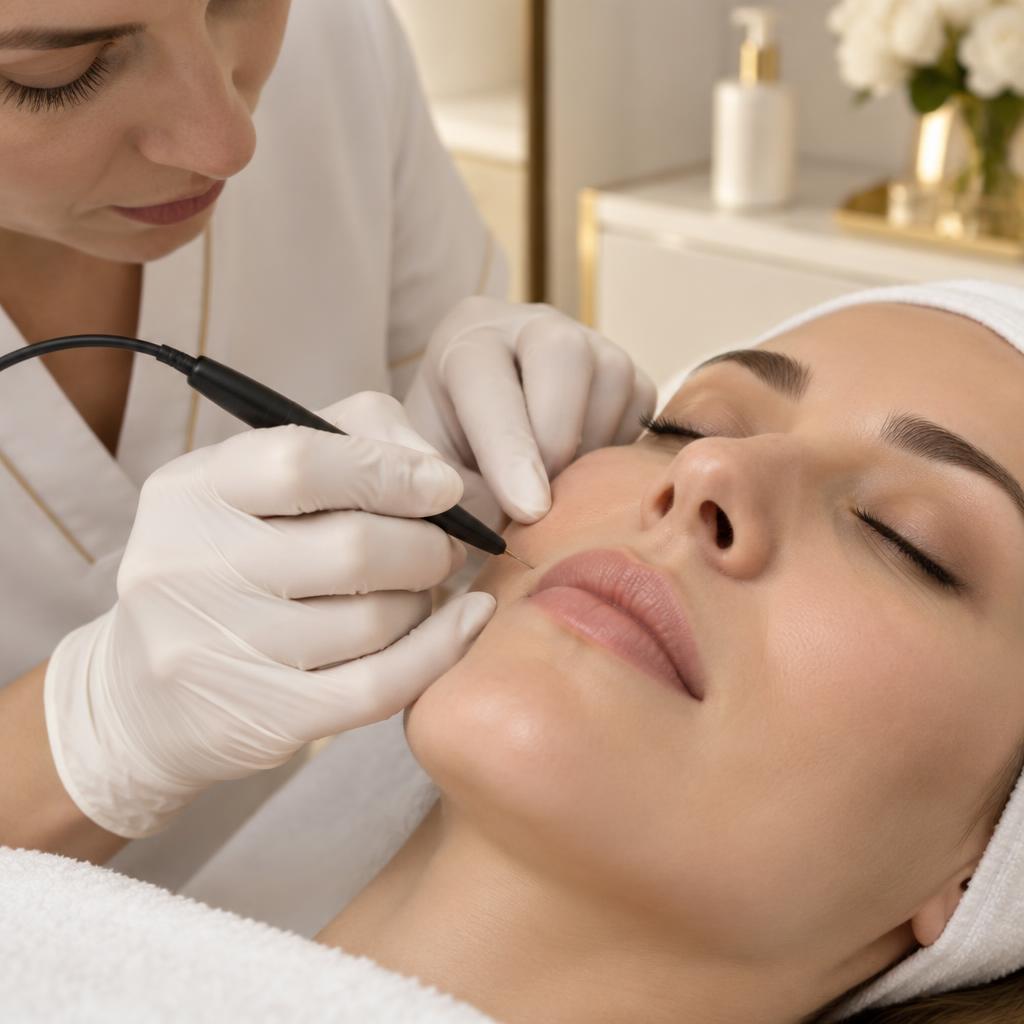
Each follicle is entered with a sterile, very fine needle suited to its structure. The needle enters the follicle from which the hair grows, and a controlled electrical current is applied with the aim of destroying the root structures that enable the hair to regrow.
Because it targets the hair follicle itself rather than the hair's colour, as laser treatment does, it delivers definitive and permanent results regardless of hair colour, hair thickness or skin tone.
Because the follicles are treated one by one, electrolysis is a personalised procedure that requires patience and regular sessions.
Is Electrolysis a Permanent and Definitive Solution?
It is possible to get rid of white, blonde, red and fine hairs that laser hair removal cannot detect.
Achieve smooth skin once and for all with electrolysis, the only method approved by the US Food and Drug Administration (FDA) for permanent hair removal.
How Is Electrolysis Performed?
The procedure is carried out with great precision and control.
The entire process is carried out by a specialist to high hygiene standards.
Who Is Electrolysis Suitable For?
Electrolysis is particularly the most appropriate and only solution in the following cases:
Laser hair removal may not be suitable for every area because of the hair's structure or the area's characteristics. Electrolysis should be preferred for the following areas in particular, where fine hairs occur and there is a risk of paradoxical hair growth (increased hair growth) after laser treatment:
What You Need to Know Before Your Session
Why do hairs need to be long before electrolysis?
How Many Minutes Does Electrolysis Take?
The duration depends on two things: the size of the area and the density of the hair. The times below are average estimates for a single session.
| Area | Duration |
|---|---|
| Between the eyebrows | 10–15 min |
| Brow shaping (one brow) | 15–25 min |
| Upper lip | 15–25 min |
| Chin | 15–30 min |
| Sideburns | 20–40 min |
| Cheeks | 20–40 min |
| Neck | 30–45 min |
| Nape of the neck | 30–60 min |
| Inside / outside the ears | 15–30 min |
| Inside the nose | 10–15 min |
| Area | Duration |
|---|---|
| Décolletage | 30–60 min |
| Nipples | 15–30 min |
| Between the breasts | 30–60 min |
| Abdominal line | 20–40 min |
| Entire abdomen | 60–120 min |
| Bikini area | 30–60 min |
| Brazilian | 45–90 min |
| Area | Duration |
|---|---|
| Shoulder (one) | 60–120 min |
| Back (half) | 90–180 min |
| Lower back | 30–60 min |
| Area | Duration |
|---|---|
| Underarm (one) | 30–60 min |
| Forearm | 60–120 min |
| Upper arm | 60–120 min |
| Backs of hands / fingers | 20–40 min |
| Lower leg | 90–180 min |
| Upper leg | 90–180 min |
| Entire leg | 3–5 hours |
| Tops of feet / toes | 20–40 min |
How Many Sessions Does Electrolysis Take?
Electrolysis is not completed in a single session. Its permanence is definitive, but because different follicles become active at different times, the procedure is divided into sessions. The total time depends on the following:
| Area | Sessions |
|---|---|
| Between the eyebrows | 3–5 sessions |
| Upper lip | 4–12 sessions |
| Chin | 6–12 sessions (the most persistent area because it is hormonal) |
| Sideburns | 4–8 sessions |
| Neck / nape of the neck | 4–8 sessions |
| Décolletage / nipples | 4–8 sessions |
| Underarms | 4–6 sessions |
| Bikini / Brazilian | 5–12 sessions |
| Shoulders / back | 6–12 sessions |
| Legs / arms | 6–12 sessions (2–6 sessions for hairs remaining after laser treatment) |
Important: The numbers above are estimates of the total sessions needed to eliminate all hairs in the same area and vary from person to person. Sessions are spaced 2–4 weeks apart for the face and 4–8 weeks apart for the body. Removing or cutting hairs between sessions affects the number of sessions required.
During a free initial consultation, we give you an estimate of the number of sessions and total duration; we do not want to give misleading figures over the phone.
Is There Redness After Electrolysis?
Yes, mild redness is entirely normal and expected. Because current is applied to the hair follicle, controlled irritation occurs there, and the body sends blood to the area to help it heal. Redness is a sign that the procedure has been carried out correctly and that the follicle has been destroyed.
| Area | Duration |
|---|---|
| Face | Subsides within 2–6 hours |
| Body | 12–48 hours |
| Sensitive skin | Up to 48 hours |
Tiny pinhead-sized swellings and pinpoint scabbing at needle insertion points are also normal. They fall away on their own within five days on the face and 15 days on the body.
Can I Return to Daily Life After Electrolysis?
Yes, you can return to work or school as soon as the session is over. There may be very mild redness on the face, which fades within a few hours. Most of our clients come in during their lunch break and return to work after their session.
What to avoid for the first 24–48 hours
In short, your social life need not stop. You only need to treat your skin gently on the day of the session; by the following morning, almost all the redness will have gone.
Will Electrolysis Leave a Scar or Blemish?
No, it will not. When carried out by the right specialist, with the right device and technique, electrolysis is the only FDA-approved permanent hair removal method that leaves no scars or blemishes. The procedure targets only the hair follicle and does not damage the surrounding tissue.
We use an FDA-approved Apilus device
Standard hair removal devices on the market are not the same as Apilus. Apilus is the most advanced technology, destroying the follicle with a much lower current in a much shorter time. This allows a comfortable procedure without the risk of burning the skin or leaving a scar. All the needles we use are reserved for each client, single-use and sterile.
25 years of professional experience
This work is not just about the device; it requires a sensitive hand and experience. With 25 years of expertise in skin care and permanent make-up, we analyse the hair's growth angle and depth and your skin type so that the needle reaches the follicle with millimetre precision; we apply the correct current dosage without putting your skin at risk.
The slight pinkness and pinpoint scabbing you may see after the procedure are not scars; they are proof that the follicle has dried out successfully. The scabs fall away on their own within 2–7 days. All we ask is that you do not pick the scabs, avoid make-up for the first 48 hours and follow the aftercare we recommend.
Does Electrolysis Hurt?
The pain is not unbearable. It is a momentary sensation like a mild mosquito bite or the snap of a rubber band. Although pain thresholds vary from person to person, most of our clients leave their sessions satisfied, saying it was not as bad as they had imagined.
The pain is caused by the current delivered to the hair follicle, which heats and destroys it. That momentary heat shows that the procedure is being carried out correctly.
Why does it hurt less here?
With older devices, the current stays in the follicle longer and causes more pain. The Apilus technology we use delivers current in a thousandth of a second and dries out the follicle immediately. This both significantly shortens the procedure and minimises pain.
Electrolysis Prices
As elsewhere in the world, electrolysis prices at our salon are calculated solely by the minute. Whether the hair is fine, thick, white or blonde does not change the price; there is just one rate: the cost per minute.
Total cost = price per minute × total treatment time. As the number of hairs falls, your treatment time becomes shorter and the amount you pay decreases accordingly. There is no fixed price by area, so you pay only for the treatment you receive; package prices are not used for electrolysis.
Simply contact us on WhatsApp for our current rate per minute and an estimate of the time needed for you.
Frequently Asked Questions
1. Does electrolysis hurt?
No, the pain is not unbearable; you feel a brief warmth. Because the FDA-approved Apilus device delivers current in a thousandth of a second, it hurts much less than older devices.
2. Will it leave a scar or blemish?
No. When carried out by the right specialist with the right device and a sterile, single-use needle, it leaves no scars or blemishes. With 25 years of experience, we target only the hair follicle without damaging your skin.
3. How are prices calculated?
Solely by the minute. Total cost = price per minute × total treatment time. As the number of hairs decreases, so do your treatment time and cost.
4. How many sessions does it take?
It varies from person to person; because hair grows in cycles, treatment is not completed in one session. Hair that has never been treated takes less time. At a free initial consultation, we draw up a clear plan for you.
5. How long is one session?
It varies by area: 10–15 minutes between the eyebrows, 15–25 minutes for the upper lip and 15–30 minutes for the chin. The Apilus device allows procedures to be completed more quickly.
6. Can I return to daily life after a session?
Yes, you can return immediately. You only need to avoid make-up, strong sun, swimming pools and strenuous exercise for the first 24 hours. Mild redness passes within a few hours.
7. Laser hair removal or electrolysis?
Laser treatment is effective on thick, dark hair; it cannot detect blonde, white or fine hairs or hormonal chin and upper-lip hairs, and it can increase hair growth in some facial areas. Electrolysis is the permanent and only solution regardless of hair colour.
8. Is it effective on white and blonde hairs?
Yes, that is its greatest advantage. Because laser treatment cannot detect white hair, electrolysis is the only permanent solution.
9. Is it permanent? Will the hair grow back?
It is permanent. A follicle destroyed with the correct technique will not grow another hair; this is the only method approved by the FDA for permanent hair removal.
10. Can men have it?
Yes. It is the most effective method for our male clients, particularly on the nape of the neck, shoulders, back, area above the beard, and inside the nose and ears.
11. Can it be done inside the nose and ears?
Yes, it can be carried out safely, provided it is done by a specialist. Laser treatment is not suitable for these areas.
12. Can it be done in every season?
Yes, it can be carried out throughout all 12 months of the year, including summer.
13. Can it be done during pregnancy?
It is not recommended during pregnancy as a precaution.
14. How is hygiene maintained?
A sterile, single-use needle reserved for each client is opened in front of you, and the treatment is then provided to you.
15. Can it be done on every area?
Yes, it can be carried out safely on almost every part of the body. Its greatest advantage is that it can be applied to areas where laser cannot be used or is considered risky.
16. Is it harmful in the genital area?
No. When carried out by the right specialist with the right device and complete hygiene, it is one of the safest and most permanent methods for the genital area.
17. What should I pay attention to afterwards?
Do not apply make-up to the area for the first 24 hours; avoid hot showers, Turkish baths, saunas, swimming pools and strenuous exercise. Do not pick the scabs; they will fall away on their own.
18. Who should not have it?
As a precaution, it is not carried out on people with pacemakers or epilepsy, pregnant people, those with an active cold sore, wound or infection in the area, or those undergoing chemotherapy.
19. Can it be done during menstruation?
Technically, yes, but because the body is more sensitive, the pain is felt much more intensely.
20. Can it be done in summer?
Yes, it can be carried out throughout all 12 months of the year; unlike laser treatment, it has no season.
21. Can I tweeze hairs between sessions?
No. Removing the follicle with tweezers, wax or threading affects the outcome. Shortening hairs with a razor or scissors between sessions also prolongs the process.
22. Can it be done on brows?
Yes, it is the most permanent and precise method of brow shaping. Laser treatment cannot be used on the fine hairs between or beneath the brows; electrolysis is the only solution. Thanks to our expertise in permanent make-up, we work without disturbing your brow line and preserve its most natural shape.
23. How many hours does leg treatment take?
It cannot be completed in one session and is divided into several sessions. Because there are so many hairs on the legs, it is not appropriate to treat an entire leg at once; we proceed area by area.
24. What is the maximum number of minutes in one session?
There is no time limit. The treatment duration depends on the person's pain threshold and sensitivity that day, as well as the specialist's working comfort.
25. How should the hairs be before treatment?
For the best result, the hairs need to remain rooted beneath the skin and be long enough to be visible above its surface.
Prices and appointments
Ask about Electrolysis
Let our specialist team assess your needs and provide a personalised session plan and price information.
Ask AI
Ask AI about Electrolysis
Click the AI platform you want
Related services